

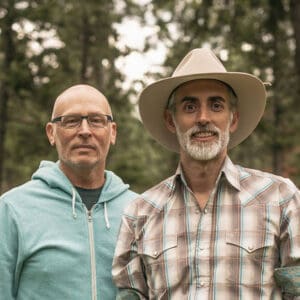
Robert Grover & Gary Logan
Spiritual Advisors
Psilocybin and SSRIs. What the emerging science of safe guided retreats actually reveals
So you are on an SSRI and you believe that disqualifies you from a guided psilocybin experience. It does not. That belief, while widespread, is not supported by the clinical evidence, and it has kept far too many people from work that could genuinely serve them.
At The Journeymen Collective we have guided people through powerful, life-changing ceremonial experiences while they were on SSRIs. We have seen them access genuine depth, genuine clarity, and genuine shift. The medicine found them. The container held. The experience was real.
The science is now confirming what our practice has long demonstrated.
The assumption the field is moving past
For a long time, a categorical rule traveled through both scientific literature and psychedelic communities. If you were taking a selective serotonin reuptake inhibitor, you could not safely engage in psilocybin work. You needed to taper, wait, clear the medication entirely, and only then consider a guided experience. This rule had a kind of provisional logic during an earlier era of research. Clinical trials wanted clean variables. They were conservative about theoretical risks, and serotonin toxicity, a real medical condition typically associated with combinations of drugs that dramatically overstimulate serotonin receptors, was treated as a live concern even when the pharmacological evidence for that concern was thin.
The research base has grown considerably since those original protocols were written. The field is now asking harder questions and arriving at more nuanced answers. The evidence is consistent, and it points in one direction.
What the neuroscience actually shows
The core concern behind the SSRI exclusion was always serotonin toxicity. The fear was that combining an SSRI, which maintains elevated serotonin signaling, with psilocybin, which activates serotonin receptors, would push that system into dangerous territory. The clinical record tells a different story.
Therapeutic psilocybin does not raise serotonin levels to dangerous ranges. The mechanism through which it works, primarily through 5HT2A receptor activation rather than flooding the system with serotonin itself, is meaningfully different from the drug combinations that actually produce serotonin syndrome. This distinction matters, and it is one of the reasons the outcomes researchers are observing in combined medication contexts are so different from what the old rule predicted. The full picture of what psilocybin does to the brain, including how it disrupts the default mode network, generates neuroplasticity, and makes the reticular activating system’s confirmation filters temporarily available to be remade, is explored in depth in our article on rewiring your mind with psychedelics.
What SSRIs consistently do in combination with psilocybin is not block the experience. They attenuate it. The depth, the emotional resonance, and the clarity of the experience are reduced when an SSRI is present. This is not nothing, and it is precisely why we still encourage clients to taper before a journey when medically appropriate. But attenuation and toxicity are categorically different outcomes, and conflating them has cost many people access to an experience that might genuinely have served them.
What five peer reviewed studies are finding
The clinical research is consistent, growing, and pointing the same way across every study that has looked at this seriously.
A 2023 phase two clinical trial in Neuropsychopharmacology led by Goodwin and colleagues allowed participants to remain on their SSRI throughout the study. There were no cases of serotonin syndrome. Psilocybin remained therapeutically effective, and participants were monitored carefully for three weeks with no adverse safety events related to the combination.
The following year, a study published in Frontiers in Psychiatry by Do and colleagues documented a client on two serotoninergic antidepressants successfully completing psilocybin assisted therapy sessions. There were no cases of toxicity, no cardiovascular concerns, and no adverse safety events of any kind. The serotoninergic antidepressants combination in psilocybin assisted psychotherapy, in this particular case, produced neither the harm the old rule predicted nor the barrier it assumed.
A large survey from Gukasyan and colleagues in the Journal of Psychopharmacology confirmed the attenuation effect across a broad sample. SSRIs and SNRIs reduced the intensity of the psilocybin experience, as expected. Signs of serotonin toxicity were extremely rare, consistent with the clinical trial findings.
In September 2025, the Johns Hopkins National Network of Depression Centers published a consensus statement in The Lancet’s eClinicalMedicine on the integration of psilocybin into clinical care. The statement reflects the movement in institutional understanding away from blanket exclusion and toward individual assessment for people taking serotonergic medications, which is precisely the approach we have held since the beginning.
And in November 2025, a qualitative analysis published in ScienceDirect examining naturalistic reports of psilocybin combined with serotonergic antidepressants found no distinct cases of serotonin toxicity in the psilocybin group. The overall picture with psilocybin, across both clinical and naturalistic contexts, is consistent: attenuation is the primary outcome, not danger.
Taken together, these studies are not outliers. They represent a maturing field arriving at the same conclusion from multiple directions.
How we work with this at The Journeymen Collective
Our position has always been more nuanced than the binary the old rule created. We did not wait for the science to catch up. We were already working this way, guided by what we were seeing in our clients and what we know about skilled, individualized facilitation.
Our preference remains that clients not be on an active SSRI when preparing for deep ceremonial psilocybin work. The reason is straightforward. These medications reduce the emotional depth, the clarity, and the resonance of the experience. We want the medicine to have full access to the person, and an active SSRI often limits that. When it is medically safe and appropriate, we encourage a thoughtful taper in collaboration with a health care provider, on a timeline that protects the client’s wellbeing.
We also know that medication is not a simple variable, and we do not ask anyone to treat it as one. A person who has been stable on an SSRI for years, whose quality of life and professional functioning depend on that stability, faces a genuine and personal question when they are drawn toward this work. Asking them to stop a medication that keeps them functional, on an arbitrary timeline, without adequate medical support, is not a position grounded in the kind of care this work demands.
What we offer is precision rather than prohibition, and those are not the same thing. Every person who comes to us goes through a thorough individual screening process that includes a full review of their medications, their history, their readiness, and their intention. We collaborate with health care providers. We adjust preparation timelines and dosage approaches individually. We have seen people do genuinely meaningful, genuinely safe ceremonial psilocybin work while on SSRIs, and we have seen people for whom the attenuation was significant enough that we recommended they taper first. The determination is always individual, always grounded in the specific person and what they are actually carrying. For those navigating trauma and PTSD alongside medication, this distinction matters especially.
This is the frontier the science is now illuminating. Not a frontier of recklessness, but of precision, of honesty about what the evidence actually shows, and of the kind of sophisticated guided experience that takes the whole person seriously.
What this means for you
If you have been on an SSRI and have felt, because of that fact, that this kind of work was simply not available to you, know that it is more available than you have been told. The path toward a journey begins with a conversation, a thorough and honest one, about where you are, what you are carrying, and what the work actually requires. Our complete guide to psilocybin retreats in Canada and the USA walks through the full arc of what that preparation involves, from the initial screening through the ceremony and into the integration that follows.
The science is not finished. This field will continue to evolve, and so will our understanding of how medications, neuroscience, and ceremonial wisdom intersect. What is clear now is that medication is one factor among many, that attenuation is not the same as danger, and that the question of readiness is always more complex and more personal than a single variable can answer.
What would it mean to have that conversation?
If something in this article opened a question, we invite you to explore whether a journey might be the right next step.
Frequently asked questions
Does psilocybin cause serotonin syndrome when combined with SSRIs?
The clinical evidence consistently shows that therapeutic psilocybin does not raise serotonin levels to dangerous ranges when combined with SSRIs. Multiple clinical trials and large surveys have found that the most common outcome of this combination is a reduction in the intensity of the experience rather than a health risk. Serotonin syndrome has not been documented in guided psilocybin sessions where SSRIs were present.
Should I stop my SSRI before a psilocybin retreat?
Our preference is that clients are not on an active SSRI when preparing for deep ceremonial psilocybin work, because these medications typically reduce the emotional depth and clarity of the experience. We encourage tapering when it is medically safe and appropriate, always in honest collaboration with a health care provider. We never ask anyone to stop their medication without proper medical guidance and support.
What happens to the psilocybin experience when someone is on antidepressants?
SSRIs and SNRIs typically reduce the intensity of the psilocybin experience rather than blocking it entirely. In practice this means the medicine may require a higher dose to reach the same depth of processing that someone without these medications would access at a lower dose. We account for this individually through our screening, preparation, and dosage approach.
Is it safe to go on a psilocybin retreat while taking medication?
Safety arises from skilled facilitation, thorough screening, careful preparation, and attentive dosage. Being on an SSRI is one factor among many that we assess individually in our screening process. Our complete guide to psilocybin retreats in Canada and the USA walks through what to look for in a provider and how the full screening process works.
What does the research show about serotoninergic antidepressants in psilocybin assisted therapy?
The emerging research shows that serotoninergic antidepressants in psilocybin assisted therapy is far safer than earlier clinical rules assumed. A 2024 study in Frontiers in Psychiatry documented a client on two serotonergic antidepressants completing psilocybin assisted therapy sessions with no toxicity or cardiovascular concerns. A 2025 qualitative analysis found no distinct cases of serotonin toxicity with psilocybin in combined medication contexts. A 2025 consensus statement from the Johns Hopkins National Network of Depression Centers reflects the movement in clinical understanding toward individual assessment rather than automatic exclusion.
About the authors
Rob Grover is a co-founder of The Journeymen Collective, guiding accomplished leaders through transformative leadership work and expertly guided plant medicine journeys.
Gary Logan is a co-founder of The Journeymen Collective, holding the science and wisdom of plant medicine and guiding accomplished leaders through deep transformative work.