

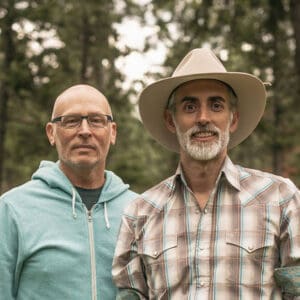
Robert Grover & Gary Logan
Spiritual Advisors
Rewiring your mind with psychedelics. What the science actually says
Something happens inside a guided psilocybin experience that accomplished people struggle to put language around afterward. They reach for words like clarity, or opening, or seeing myself for the first time. What they are describing, in the precise language of neuroscience, is neuroplasticity in real time, the brain’s capacity to reorganize itself, to form new connections across regions that had hardened into habitual isolation, to become genuinely available to new ways of perceiving and being.
The research is now substantial enough to say this plainly. Psilocybin rewires the brain. A single dose induces the rapid growth of new dendritic spines, the structures through which neurons communicate, in the frontal cortex, with effects lasting at least a month. A study published in Cell in 2025 mapped this structural remodeling across large scale cortical networks in precise detail. Nature Reviews Neuroscience followed in early 2026, confirming that psilocybin shapes neural plasticity in selective brain networks in ways that may explain its sustained effects on behavior long after the compound itself has left the body.
The question worth sitting with is not whether the rewiring happens. It is how, and why it reaches places that decades of insight, therapy, and intellectual understanding have consistently left untouched.
The filter running beneath your awareness
To understand what psychedelics are doing in the brain, it helps to first understand what the brain has been doing all along without them.
At the base of your brainstem sits a structure roughly the size of your little finger called the reticular activating system. It functions as the brain’s primary filter, a gatekeeper between the eleven million bits of sensory information arriving every second and the approximately forty bits your conscious mind can actually process. Everything else is edited out before it ever reaches awareness.
This filtering is a feat of extraordinary efficiency, and it comes with a consequence worth understanding. The brain must choose what matters, and that choice follows a specific logic. The reticular activating system filters incoming experience according to what you have already decided is true, what you are already looking for, and what you have already concluded about yourself. It evaluates through the lens of prior belief. It retrieves confirmation.
What this means in practice is that the world you perceive is shaped, before you are even aware of it, by decisions you made long ago. The person who decided somewhere below the reach of ordinary reflection that vulnerability means danger will organize an entire empire around the management of that belief and experience it as simply how leadership works. The person who concluded that their worth lives in their output will find the world confirming that equation at every turn, because the reticular activating system is searching for exactly that confirmation, day after day, in every room, in the silence between meetings. The filter runs. Reality is shaped accordingly. And from inside that architecture, the filtered view feels complete and accurate.
This is the first thing psychedelics are rewiring: the confirmation machinery itself.
What psilocybin does to the brain’s self referential system
The reticular activating system does its work in close relationship with the default mode network, the brain’s primary self referential system, responsible for the internal narrator, the ongoing story of who you are and what you are capable of. Researchers at Imperial College London and Johns Hopkins University have spent the last decade mapping what happens to this network under psilocybin. What they have found is genuinely arresting.
The default mode network, the system that organizes and reinforces the self concept the reticular activating system then filters reality through, temporarily loosens its grip. The incessant self referential machinery quiets. Researchers describe this as a state of unconstrained cognition, the brain freed from the ordinary demands of maintaining a consistent narrative self. Longitudinal precision brain imaging studies show that psilocybin drives more than three times the acute changes in functional brain networks compared to control compounds, with the strongest desynchronization occurring precisely in the default mode network, the region connected to the anterior hippocampus and thought to generate our sense of self.
In this state, the brain enters what neuroscientists call elevated entropy, a condition of dramatically expanded possibility in which connections form across regions that ordinarily operate in separation, and information reaches awareness that the default filters would ordinarily hold back. Psilocybin activates 5HT2A receptors, triggering the release of brain derived neurotrophic factor (BDNF), the key protein that supports neuron growth and connectivity, and engaging the mTOR signaling pathway that underwrites structural synaptic change.
This is neuroplasticity at an intensity the brain rarely achieves through ordinary experience. New pathways open. Old grooves lose their dominance. The architecture that has been filtering experience, confirming old beliefs, and maintaining a particular picture of reality becomes, for a window of time, genuinely malleable.
The rewiring has begun. The question is what gets written into the new architecture.
Where science meets something older
Here is where the neuroscience converges with something older than the neuroscience.
What people most consistently report from a well prepared, well held psilocybin experience is the sudden visibility of what was always there, the belief running in the background, finally audible; the decision made decades ago, finally seen as a decision rather than as simply how things are. The filter, illuminated. This is the reticular activating system’s organizing principle surfacing into conscious awareness, perhaps for the first time.
And that illumination changes something functional. A filter that has been brought fully into awareness loses its invisibility, and it is the invisibility that gave it its power. The confirmation retrieval function operates only on beliefs held below the surface. Once a belief is recognized as a belief, once the architecture is seen as architecture, the automaticity breaks. What was invisible and therefore all governing becomes visible and therefore available to be worked with.
This is the mechanism. This is what rewiring with psychedelics actually means at the level of the brain’s own operating system.
Why the opening is just the beginning
The most important thing to understand about neuroplasticity under psilocybin is also the thing most often missed in popular conversation about plant medicine: the opening is the beginning, and only the beginning.
Elevated entropy, loosened default mode network activity, new dendritic spine growth, all of this creates the conditions for rewiring. It does so by making the brain genuinely available to new experience in a way it has likely been resisting for years. But the reticular activating system reorganizes through sustained new experience. The confirmation retrieval function rebuilds itself around whatever it encounters in the weeks and months that follow the ceremony. The direction of the rewiring, what the new architecture gets organized around, depends entirely on what the person brings to the experience and what they do with it afterward.
This is why preparation matters as much as the ceremony itself. A person who arrives without having named what they are carrying, without having done the interior work of reflection that allows the opened state to be met with genuine presence, is walking into elevated neuroplasticity without a compass. The filter loosens, the unconscious comes forward, and without the grounding necessary to meet what is there, the experience can scatter rather than illuminate.
And it is why integration is the actual work. The ceremony creates the opening. Integration is the daily practice of building into that opening, making new decisions and holding them long enough that the brain’s confirmation retrieval function begins organizing itself around a different set of truths. The four months of structured, guided work surrounding the four days at retreat exist precisely for this reason. The neuroplastic window is the invitation. Integration is walking through it, deliberately, morning after morning, until the new architecture has genuine weight.
What a journey with The Journeymen Collective actually holds, the months of preparation, the ceremony, the integration, is the container designed to ensure that the rewiring points toward something true, something chosen, something the person has named for themselves before the door opens.
The question beneath the science
There is something almost sacred about the precision of what the neuroscience is revealing. The brain’s own mechanism for confirming what we believe is also the mechanism through which we can confirm something new. The reticular activating system is working exactly as designed. The question is whose design it is operating on, the decisions made in the most limited, most frightened, most formative moments of a younger life, or the decisions made by the full, present, illuminated person you are discovering yourself to be.
Rewiring the mind with psychedelics is a phrase that can land as either hype or hope depending on where you encounter it. What the science is actually pointing to is something far more precise and far more demanding than either: a genuine window of neuroplastic possibility, opened by the medicine and held open by the quality of the container around it, within which the architecture that has been filtering your experience of reality becomes available to be consciously remade.
That is the work. The ceremony opens the door. What you build on the other side of it is everything.
What would you build, if the architecture were genuinely available to you?
If you are weighing whether this kind of experience is right for you, our complete guide to psilocybin retreats in Canada and the USA walks through every stage of a well held journey.
The Journeymen Collective has been featured by CNBC, Forbes, the Globe and Mail, and CEO Magazine as leaders in guided luxury plant medicine retreat experiences in Canada and the USA. If something in this piece opened a question in you, we invite you to explore whether a journey might be the right next step.
Frequently asked questions
Can psychedelics actually rewire your brain?
Yes. Research now confirms this at a structural level. A single dose of psilocybin induces the rapid growth of new dendritic spines in the frontal cortex, with effects lasting at least a month. Studies published in Cell in 2025 and Nature Reviews Neuroscience in 2026 map this rewiring across large scale cortical networks. The neuroplastic window created by psilocybin requires deliberate integration to build lasting new neural architecture.
What does psilocybin do to the default mode network?
Psilocybin temporarily disrupts the default mode network, the brain’s primary self referential system responsible for the internal narrator and the ongoing story of who you are. Research shows it produces more than three times the acute changes in functional brain networks compared to control compounds, creating a state of elevated neural entropy in which new connections form across regions that ordinarily operate in isolation. This is the neurological basis for the expanded perspective and self insight that guided psilocybin sessions reliably produce.
What is the reticular activating system and how does it relate to psychedelics?
The reticular activating system, or RAS, is a structure at the base of the brainstem that filters the eleven million bits of incoming sensory information down to the roughly forty bits your conscious mind processes each second. It filters reality according to what you already believe to be true, retrieving confirmation rather than evaluating evidence objectively. Psilocybin’s disruption of the default mode network temporarily suspends this filtering function, allowing beliefs and patterns operating below awareness to surface and become visible, and therefore available to change.
How long does neuroplasticity last after a psilocybin experience?
Structural changes, the new dendritic spine growth in the frontal cortex, have been shown to persist for at least a month after a single psilocybin dose. Functional network changes, including reduced connectivity between the anterior hippocampus and default mode network, last for weeks before normalizing. The durability of behavioral change depends substantially on the quality of integration in the weeks and months following the experience. The neuroplastic window is the opening. Integration determines what gets built inside it.
Is a guided psilocybin retreat necessary for rewiring to work?
The research strongly suggests that set, setting, and support are central to outcomes. Psilocybin opens a window of elevated neuroplasticity, but elevated neuroplasticity without direction can scatter as easily as it illuminates. Preparation ensures the person arrives with clarity about what they are carrying and why. Expert guidance holds the container during the experience. Integration structures the daily practice of building new decisions into the opened neural architecture. The medicine is the catalyst. The container determines what the catalyst builds.
About the authors
Rob Grover is a co-founder of The Journeymen Collective, guiding accomplished leaders through transformative leadership work and expertly guided plant medicine journeys.
Gary Logan is a co-founder of The Journeymen Collective, holding the science and wisdom of plant medicine and guiding accomplished leaders through deep transformative work.